Gemini helps untangle the mathematics of hypothetical cosmic strings
- What it is
- AI-assisted analytical approaches to an integral used to predict radiation from hypothetical cosmic strings.
- Who did it
- Michael P. Brenner, Vincent Cohen-Addad and David Woodruff.
- What it could mean
- Could improve theoretical predictions and illustrate a search workflow that combines models with numerical feedback.
See the check plan
Evidence & validation
From announcement to evidence
Discovery recorded. The source reports the evidence below; State of Proof has not independently reproduced the work.
Read the original work
Solving an Open Problem in Theoretical Physics using AI-Assisted Discovery ↗See the proposed checks
Pin the integral and assumptions, inspect one analytical route and reproduce a bounded numerical comparison.
Independent examination not started
Peer review, simulation comparisons, laboratory evidence and independent replication are distinct. Inclusion here does not establish all of them; see the record’s source and current boundary.
How we distinguish research evidence →
Calculating radiation from a hypothetical cosmic string
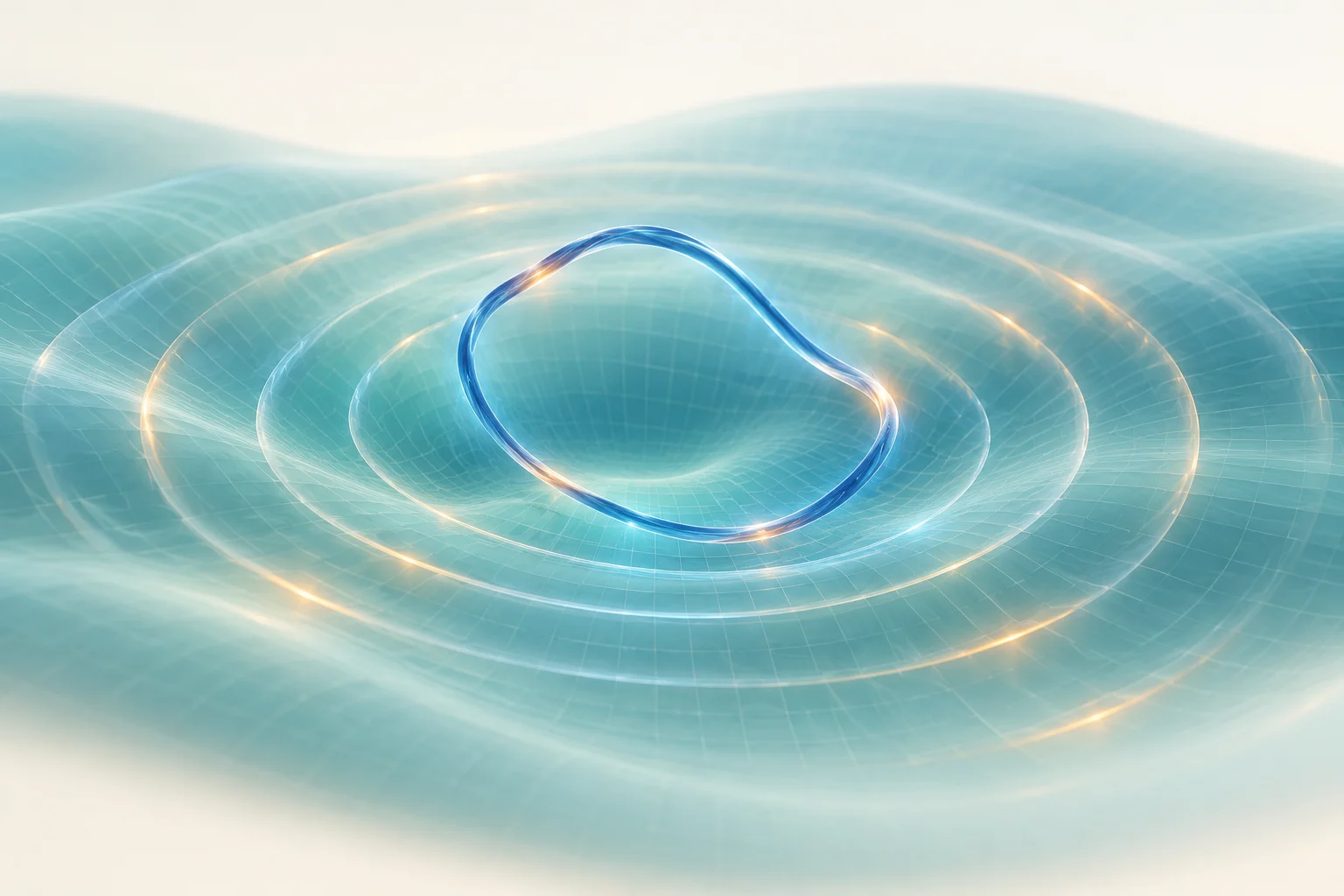
The loop and ripples introduce a theoretical radiation calculation. They do not depict an observed cosmic string, measured signal or a reproduced solution.
Read the source · Abstract · radiation integral and analytical approaches ↗- Source kind
- AI-assisted analytical result
- Evidence reported
- Analytical derivations; Reported numerical agreement
- AI role
- Gemini Deep Think explored analytical approaches within tree search and numerical feedback.
- Human role
- Researchers specified the problem and search framework and presented the mathematical derivations.
- Source date
- ; added 2026-10-15
- What it claims
- The authors report analytical methods and large-N asymptotics for an integral governing cosmic-string gravitational radiation, found with Gemini Deep Think, tree search and numerical feedback.
- Why this could matter
- Gemini helps untangle the mathematics of hypothetical cosmic strings Analytical calculations can sharpen predictions of radiation from hypothetical cosmic strings. The result concerns a mathematical model and does not show that cosmic strings exist.
- If it holds up
- A clearer analytical calculation could make this theoretical model easier to evaluate and compare with numerical predictions.
- If it does not
- Checking assumptions and asymptotics would show where the proposed analytical route breaks down.
- Impact horizon
- Foundational · Theoretical physics · Analytical mathematics
- Version
- arXiv v1
- Why we tracked it
- A March background example added to this cross-disciplinary collection in October; it is not a new October announcement.
- Highest-risk dependency
- Assumptions, singular limits and asymptotic regimes require mathematical review; numerical agreement alone is insufficient.
- Available artifacts
- Versioned manuscript with derivations, search setup and numerical comparisons; no independent replay executed.
- Current boundary
- Intake record only; examination not started. March preprint added as historical context; independent examination has not started. Neither a certified derivation nor evidence that cosmic strings exist.