A new route through matrix discrepancy
- What it is
- A proposed route for controlling signed matrix sums with a small-ball inequality.
- Who did it
- Emrullah Akbas and Suvrit Sra.
- What it could mean
- If the argument holds, one proof technique may connect several discrepancy results without spectral interlacing.
See the check plan
Evidence & validation
From announcement to evidence
Discovery recorded. State of Proof has not yet examined this claim.
Read the original work
Boolean Small-Ball Inequalities for Discrepancy Theory ↗See the proposed checks
Inspect the main inequality and every boundedness hypothesis; then trace the stated reciprocal-estimate, signing-theorem and replica dependencies to the claimed Kadison–Singer consequence. Do not execute source artifacts for this intake.
No proof docket yet
A docket is the public record of checks and open questions. This paper does not have one yet; the check plan above describes work still to do.
Explore existing proof dockets →
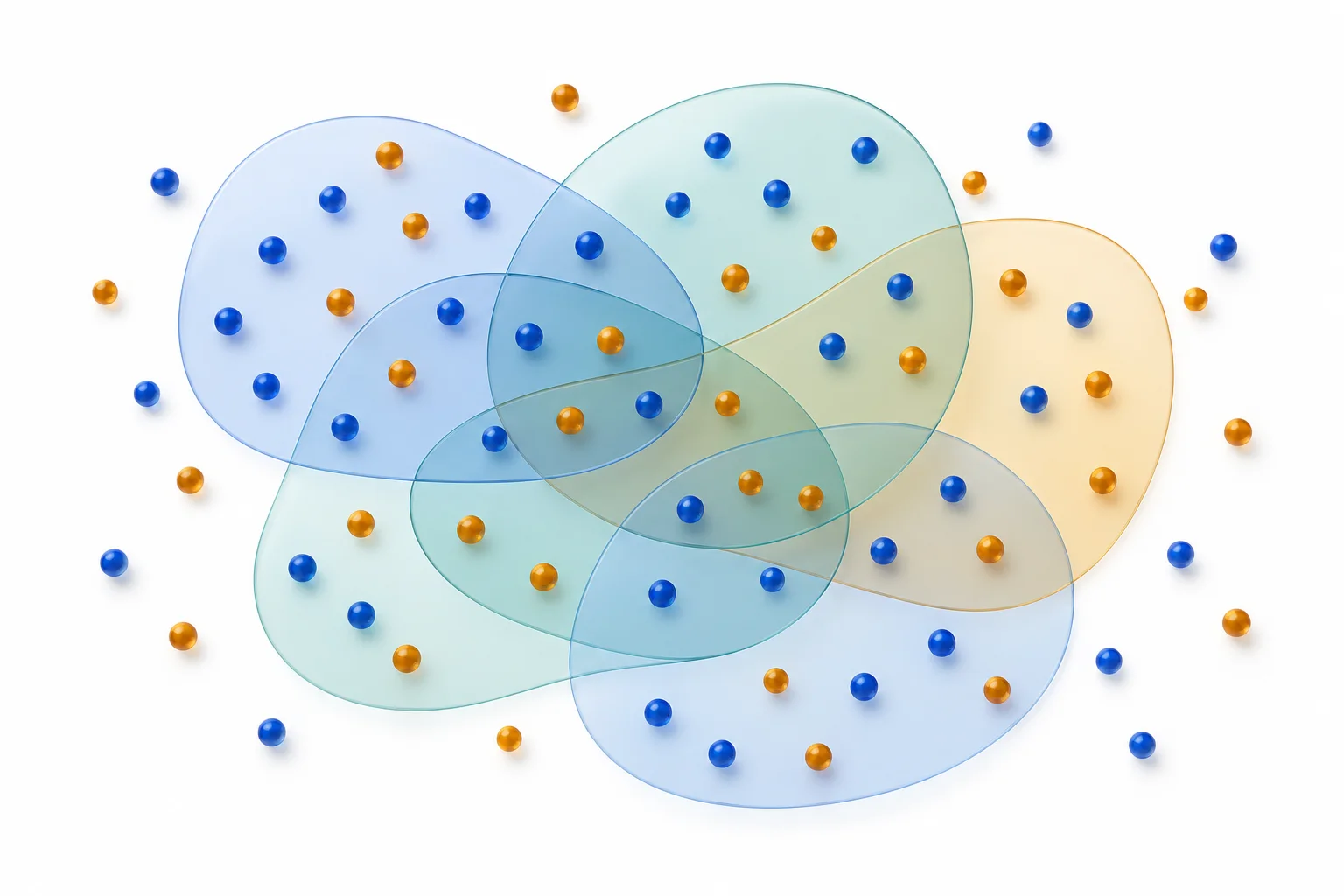
Balancing many overlapping groups
The two colors suggest opposite signs. Each overlapping group collects some of those contributions, making simultaneous balance a mathematical challenge. The picture illustrates discrepancy, not a computed coloring, a numerical bound or proof of the paper’s claims.
Read the source · Abstract · Boolean small-ball inequalities and discrepancy ↗- Source kind
- Mathematical research record
- Evidence reported
- Manuscript; independent examination not started
- Source date
- ; added 2026-09-19
- What it claims
- The abstract states a small-ball inequality for Boolean matrix series under bounded trace and variance conditions, then claims an interlacing-free proof of Kadison–Singer and further discrepancy corollaries. The explicit method and dependencies make the claimed advance an appropriate unexamined proof-method intake.
- Why this could matter
- A new route through matrix discrepancy The paper studies how random plus-or-minus choices can keep a matrix sum controlled. It offers a different proof mechanism for results about balancing many competing effects.
- If it holds up
- The method could give mathematicians another reusable way to derive matrix-balancing results and inspect which assumptions carry the work.
- If it does not
- Pinpointing a failed inequality or dependency would clarify which part of the proposed proof route cannot support its advertised consequences.
- Impact horizon
- Methods · Discrepancy theory · Matrix analysis · Proof methods
- Version
- submitted 2026-09-17 17:52:14 UTC
- Why we tracked it
- a fresh, source-backed discrepancy proof method with a stated main inequality and claimed consequence chain. Intake does not independently establish the inequality, its dependencies, or the asserted Kadison–Singer route.
- Highest-risk dependency
- The abstract-level consequence chain may conceal representation, normalization, or prerequisite assumptions; a new proof route does not by itself establish each advertised corollary.
- Available artifacts
- arXiv exposes PDF, experimental HTML and TeX source. The inspected source lists no formalization, code repository, certificate or replay package; AI involvement is not established.
- Current boundary
- Intake record only; examination not started. State of Proof has only recorded this intake. The paper's full argument remains unexamined; the next bounded check is: Inspect the main inequality and every boundedness hypothesis; then trace the stated reciprocal-estimate, signing-theorem and replica dependencies to the claimed Kadison–Singer consequence. Do not execute source artifacts for this intake.