An elusive pattern finally comes with every piece
- What it is
- An explicit table of 86 rows and columns claims to fill a missing case in a family of remarkably balanced mathematical patterns.
- Who did it
- Harshit Verma. Computer search is reported; AI involvement is not established.
- What it could mean
- Sometimes progress is an object nobody had managed to build. This one would supply a new, precisely balanced arrangement of signs, with equivalent graph and geometric forms—not an established engineering breakthrough.
See the check plan
Evidence & validation
From announcement to evidence
Discovery recorded. State of Proof has not yet examined this claim.
Read the original work
A symmetric conference matrix of order 86 ↗See the proposed checks
Transcribe the printed bit encoding twice independently; check entry conditions, symmetry and C²=85I with exact arithmetic, then inspect the graph conversion. Treat descendant counts as a separate computation.
No proof docket yet
A docket is the public record of checks and open questions. This paper does not have one yet; the check plan above describes work still to do.
Explore existing proof dockets →
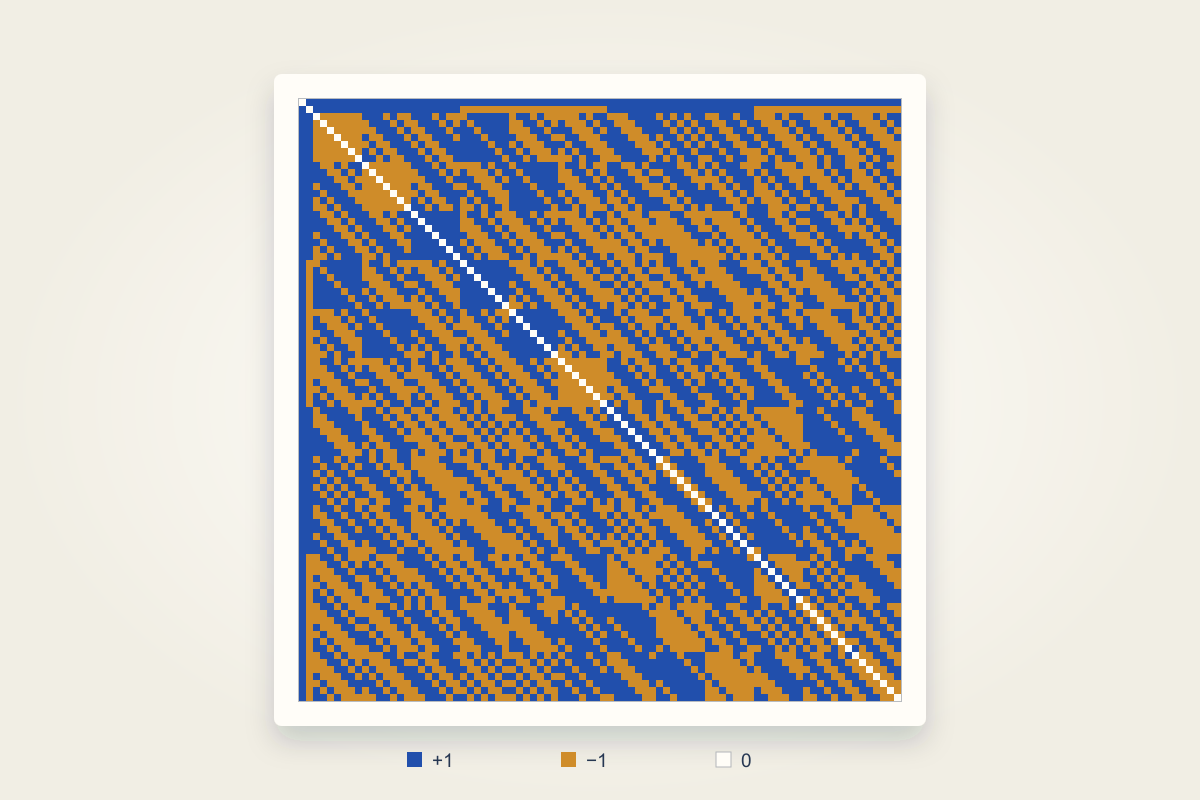
All 7,396 entries of the proposed construction
This source-derived diagram reconstructs the matrix from Section 2's printed bit encoding and border vector. Each tile is an actual entry, not decorative filler. The picture alone is not a proof of the paper's other claims.
Read the source · Section 2 · equations (2.1–2.2), explicit matrix encoding ↗- What it claims
- Theorem 1.1 claims the specified matrix exists. Equations (2.1–2.2) provide its finite encoding; Lemma 2.1 gives integer identities implying C²=85I. Theorem 3.3 reports ten isomorphism classes among the matrix's 86 descendant graphs.
- Why this could matter
- An elusive pattern finally comes with every piece Take 86 rows of positive and negative signs. Different rows must cancel perfectly when compared. The paper gives a concrete proposed construction, so this existence claim can be tested with exact arithmetic rather than an enormous search.
- If it holds up
- The order-86 existence case closes, giving researchers a concrete example and related graph and vector configurations.
- If it does not
- A transcription or construction error would need locating; a failed example alone would not prove that no such matrix exists.
- Impact horizon
- Foundational · Combinatorics · Explicit constructions · Exact computation
- Version
- arXiv v1; 2026-10-06.
- Why we tracked it
- source-reviewed mathematical intake, not a completed peer review or homepage feature.
- Highest-risk dependency
- Analyst judgment: correct bit order, circulant orientation and border reconstruction are essential; a copied encoding error can mimic a failed theorem. An explicit witness supports a finite verification route, but no verification was performed here. The construction does not classify every graph with those parameters.
- Available artifacts
- Section 2 prints a 12-by-12 array of seven-bit values and a border vector specifying an 86-by-86 integer matrix. No author-linked program was executed. A separate local exact-arithmetic witness check is retained for examination; this intake is not a full-paper verdict.
- Current boundary
- Intake record only; examination not started.