Specialists turn an AI proof into a shorter mathematical argument
- What it is
- Four mathematicians reconstruct a shorter proof of a complex-analysis bound after examining earlier AI-generated manuscripts.
- Who did it
- Ilia Binder, Oleg Ivrii, István Prause and Stanislav Smirnov; some used AI to understand the earlier work, while this writeup was produced without AI help.
- What it could mean
- The presented argument could make a major claim easier for specialists to inspect and build on. The stronger strict inequality still awaits its detailed follow-up proof.
See the check plan
Evidence & validation
From announcement to evidence
Discovery recorded. State of Proof has not yet examined this claim.
Read the original work
Brennan’s Conjecture and the Universal Integral Means Spectrum ↗See the proposed checks
Inspect the critical-point count and signed-area inequality in Section 2.2, then the boundary estimates and uniform limiting passage to general bounded conformal maps in Section 2.3. Treat the non-strict bound as the presented argument; the strict inequality's deferred details require a separate source and review.
No proof docket yet
A docket is the public record of checks and open questions. This paper does not have one yet; the check plan above describes work still to do.
Explore existing proof dockets →
How much can a conformal map stretch?
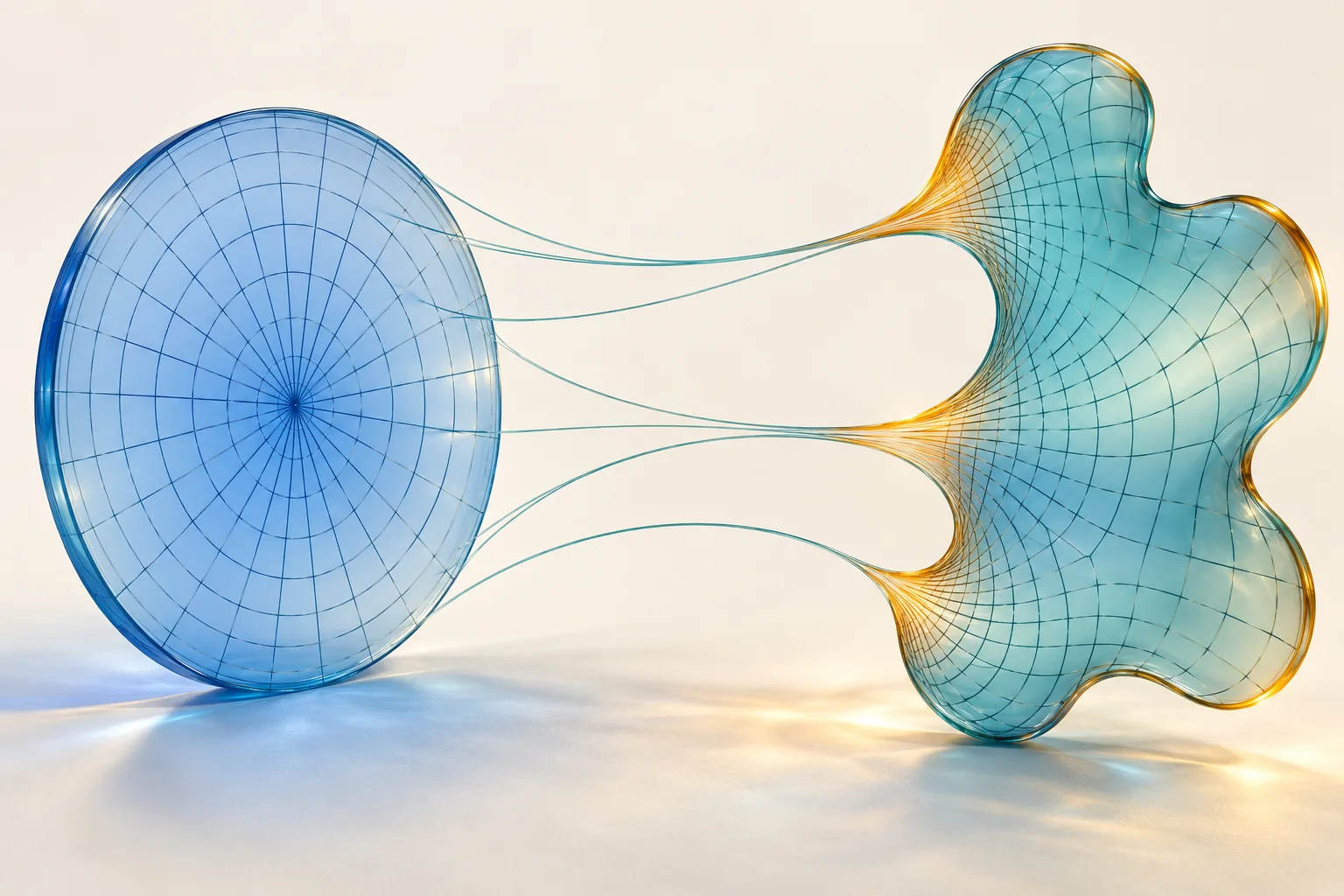
The two invented surfaces introduce changing shape and boundary distortion. Their grids are illustrative, not an exact conformal mapping, a counterexample or a plotted theorem.
Read the source · Sections 1.3–1.4 and 2 · non-strict integral-means bound ↗- Source kind
- Mathematical research record
- Evidence reported
- Manuscript; independent examination not started
- Source date
- ; added 2026-10-26
- What it claims
- Four specialists present a shorter argument for Bb(t)≤t²/4 for t∈[-2,2], following their examination of earlier OpenAI manuscripts. The paper states a strict inequality on (-2,2) excluding 0, but explicitly provides the full argument only for the non-strict bound and defers the strict-case details.
- Why this could matter
- Specialists turn an AI proof into a shorter mathematical argument Conformal maps preserve angles but can stretch distances sharply near a boundary. The paper bounds how that stretching accumulates and presents a shorter route to Brennan’s conjectured integrability range. Details of a stronger strict bound are deferred.
- If it holds up
- The non-strict spectrum bound would provide a shorter foundation for Brennan’s conjecture and a clearer starting point for further complex-analysis work.
- If it does not
- The signed-area estimate or limiting passage would need repair; the separately deferred strict claim would still require its own detailed proof.
- Impact horizon
- Foundational · Complex analysis · Conformal maps · Human–AI research
- Version
- 2026-10-16; arXiv v1; submitted October 16, 2026 at 17:59:11 UTC.
- Why we tracked it
- source-reviewed intake only; independent examination has not started.
- Highest-risk dependency
- Analyst judgment: the weighted signed-area argument, singularity control and uniform limiting passage need independent examination. Section 1.4 explicitly defers the detailed strict-inequality proof. Do not label that deferred strengthening fully proved by this note, or treat the authors' examination of earlier work as a State of Proof verdict or peer-review status.
- Available artifacts
- Pinned arXiv:2610.23853v1 supplies PDF, HTML and TeX source. No accompanying code, data or Lean repository was identified in this bounded review. No manuscript code was executed.
- Current boundary
- Intake record only; examination not started. State of Proof has only recorded this intake. The paper's full argument remains unexamined; the next bounded check is: Inspect the critical-point count and signed-area inequality in Section 2.2, then the boundary estimates and uniform limiting passage to general bounded conformal maps in Section 2.3. Treat the non-strict bound as the presented argument; the strict inequality's deferred details require a separate source and review.