A claimed faster route to measuring how shapes combine
- What it is
- A paper claims the first randomized polynomial-time approximation method for mixed volumes of arbitrary compact convex sets given by weak membership oracles.
- Who did it
- Xiaoyu Chen and Kuikui Liu; the paper says GPT-6 Astra generated the main ideas and the authors wrote the exposition.
- What it could mean
- If correct, it would replace an assumed barrier in a geometric counting problem. It does not establish a deployed optimization method or a performance result outside the stated oracle model.
See the check plan
Evidence & validation
From announcement to evidence
Discovery recorded. State of Proof has not yet examined this claim.
Read the original work
An FPRAS for Mixed Volumes ↗See the proposed checks
Fix the weak-membership-oracle model, approximation guarantee, success probability and input representation; trace the smoothing, rounding and sampling reductions to the stated FPRAS bound; compare the exact scope with Gurvits's 2009 conjecture before calling it a disproof.
No proof docket yet
A docket is the public record of checks and open questions. This paper does not have one yet; the check plan above describes work still to do.
Explore existing proof dockets →
Estimating the overlap of many shapes
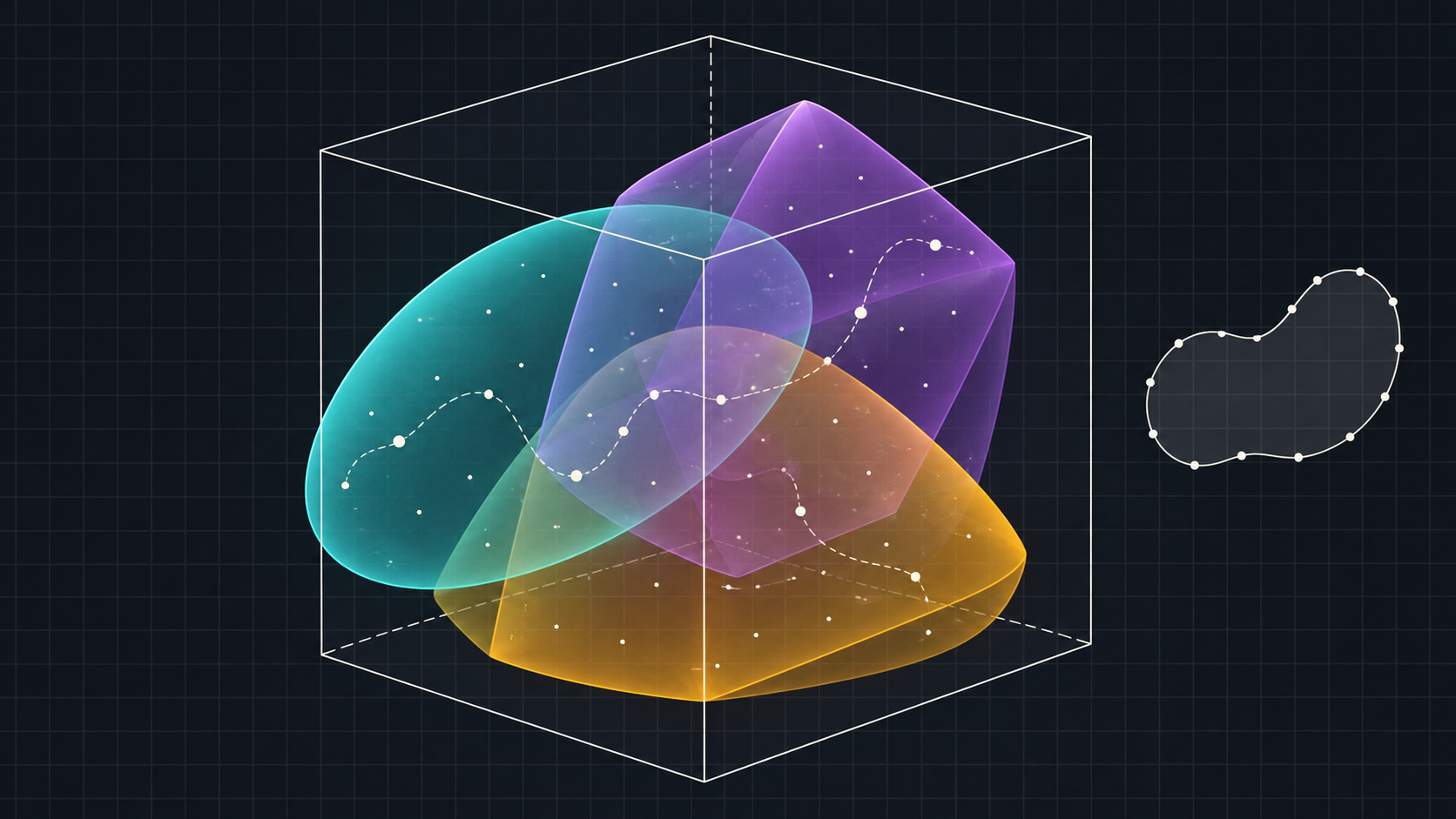
The translucent bodies and points introduce mixed volumes and randomized approximation. They are invented geometry, not the paper's algorithm, an oracle input, a proof figure or a measured performance result.
Read the source · Abstract and Sections 1.1–1.4 · mixed-volume FPRAS and AI disclosure ↗- Source kind
- Mathematical research record
- Evidence reported
- Manuscript; independent examination not started
- Source date
- ; added 2026-11-03
- What it claims
- The abstract claims an FPRAS for mixed volumes in the weak-membership-oracle model and names a 2009 Gurvits conjecture as disproved. Its explicit disclosure says GPT 6 Astra generated the main ideas entirely; the authors state that the paper provides a human-written exposition of the algorithm. This is a new primary preprint, not a proof verdict.
- Why this could matter
- A claimed faster route to measuring how shapes combine Mixed volume measures how several geometric shapes interact. The paper claims a randomized way to estimate it efficiently from limited membership queries, overturning a 2009 conjecture. The argument is not independently examined here.
- If it holds up
- It would give researchers a new general approximation tool and revise an assumed computational limit in convex geometry.
- If it does not
- A gap in the reduction, sampling analysis or oracle model would limit the claim without restoring the old conjecture automatically.
- Impact horizon
- Methods · Convex geometry · Randomized algorithms · Computational complexity
- Version
- submitted 2026-11-01 00:09:52 UTC
- Why we tracked it
- primary manuscript, author attribution and explicit AI disclosure were inspected; State of Proof has not independently examined the proof, randomized analysis, reduction, or complexity bounds.
- Highest-risk dependency
- The FPRAS claim depends on oracle access, randomized complexity and the reductions from arbitrary compact convex sets. The AI disclosure establishes provenance, not correctness. No practical scheduling, volume-computation or optimization speedup follows from source intake.
- Available artifacts
- arXiv supplies PDF, experimental HTML and TeX source. No formal proof, code repository, executable artifact, certificate, benchmark, peer review, or independent replication was identified or run in this intake.
- Current boundary
- Intake record only; examination not started. State of Proof has only recorded this intake. The paper's full argument remains unexamined; the next bounded check is: Fix the weak-membership-oracle model, approximation guarantee, success probability and input representation; trace the smoothing, rounding and sampling reductions to the stated FPRAS bound; compare the exact scope with Gurvits's 2009 conjecture before calling it a disproof.