Finding the next question inside millions of brain-cell measurements
- What it is
- A study distributes interpretation of a mouse-brain experiment across thousands of agents and compares the resulting reports with existing findings and expert judgments.
- Who did it
- Researchers at Scripps Research, OpenAI, PerturbAI, UC San Diego and HHMI, with blinded biological expert reviewers.
- What it could mean
- Could help scientists extract more testable questions from experiments they have already performed, while keeping the supporting observations visible.
See the check plan
Evidence & validation
From announcement to evidence
Discovery recorded. The source reports the evidence below; State of Proof has not independently reproduced the work.
Read the original work
Distributed AI agents enable comprehensive discovery of biological insights at scale ↗See the proposed checks
Inspect held-out-data and literature-leakage controls, a fixed sample of claim-to-data links, and the scope of expert comparisons before considering prospective evaluation.
Independent examination not started
Peer review, simulation comparisons, laboratory evidence and independent replication are distinct. Inclusion here does not establish all of them; see the record’s source and current boundary.
How we distinguish research evidence →
Many analyses, one biological atlas
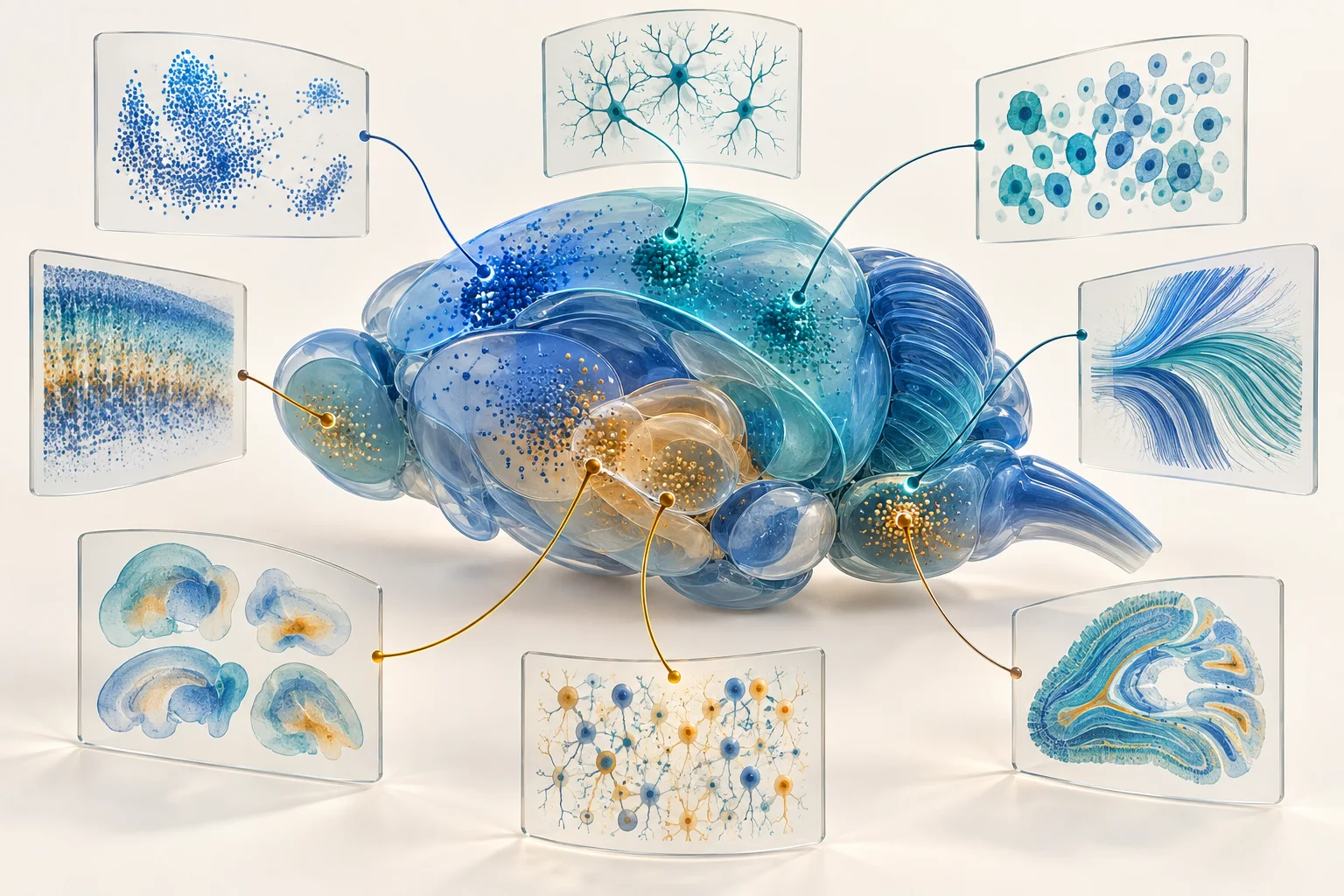
The brain and panels introduce parallel interpretations of a mouse-brain dataset. All cellular forms, dot patterns and atlas panels are invented illustration; none are source data or newly validated mechanisms.
Read the source · Abstract and evaluation · distributed reports and blinded expert comparisons ↗- Source kind
- AI-assisted biological interpretation study
- Evidence reported
- Retrospective recovery of source-study findings; Held-out perturbation prediction; Blinded expert comparison
- AI role
- GPT-Rosalind-5.5 agents interpreted individual perturbations, searched literature and assembled evidence-linked explanations and follow-up priorities.
- Human role
- Researchers generated the mouse-brain experiment, designed the analysis and evaluation, and recruited biological experts to assess reports.
- Source date
- ; added 2026-10-26
- What it claims
- The authors report that 1,946 agents interpreted a mouse-brain perturbation atlas, recovered 48 of 55 source findings directly supported by the supplied expression data, and generated reports preferred in 45 of 60 blinded paired expert judgments.
- Why this could matter
- Finding the next question inside millions of brain-cell measurements Dividing a large brain-cell dataset among agents can help scientists connect each gene disruption with earlier research. The resulting reports may help them choose focused experiments, but recovered findings and expert preferences do not establish that new biological explanations are correct.
- If it holds up
- Researchers could spend less time assembling scattered literature and more time judging which specific biological questions deserve experiments.
- If it does not
- Independent datasets or prospective tests would reveal where plausible explanations and expert preferences fail to identify useful biological leads.
- Impact horizon
- Methods · Biological data interpretation · Experimental prioritization · Neuroscience
- Version
- bioRxiv v1; posted October 16, 2026; announced by OpenAI October 21
- Why we tracked it
- The October 16 preprint and October 21 announcement fall within this catch-up window. The DOI contains October 15, but the official posting date is October 16.
- Highest-risk dependency
- Retrospective recovery and expert preference do not confirm new mechanisms. Generalization needs independent datasets and prospective experiments; estimated human effort is not measured human performance.
- Available artifacts
- Versioned bioRxiv manuscript; https://github.com/jinlabneurogenomics/distributed_agent at observed commit 75a0ed7defc92853ab789a0e571784b9ec2a5999 (October 24) supplies reports, corpus tooling and analysis notebooks; its software and documentation are MIT-licensed. Underlying atlas: https://huggingface.co/datasets/perturbai/wholebrain_crispr_atlas, CC BY 4.0. No code or data analysis executed here.
- Current boundary
- Intake record only; examination not started. Preprint intake only; independent examination and replication have not started. The output is a set of research leads, not established disease mechanisms, treatments or clinical benefits.