AI points toward an overlooked way cells exchange cargo
- What it is
- A study combining predicted protein structures with experiments on cellular exchange and material recycling.
- Who did it
- Kyutae D. Lee and collaborators at the University of Miami.
- What it could mean
- Could improve understanding of how cells connect, share organelles and regulate autophagy.
See the check plan
Evidence & validation
From announcement to evidence
Discovery recorded. The source reports the evidence below; State of Proof has not independently reproduced the work.
Read the original work
TM184C is a GPCR-like regulator of intercellular exchange and autophagy ↗See the proposed checks
Examine controls and causal scope, including endogenous versus overexpressed protein evidence, before proposing an independent replication.
Independent examination not started
Peer review, simulation comparisons, laboratory evidence and independent replication are distinct. Inclusion here does not establish all of them; see the record’s source and current boundary.
How we distinguish research evidence →
How cells exchange cargo
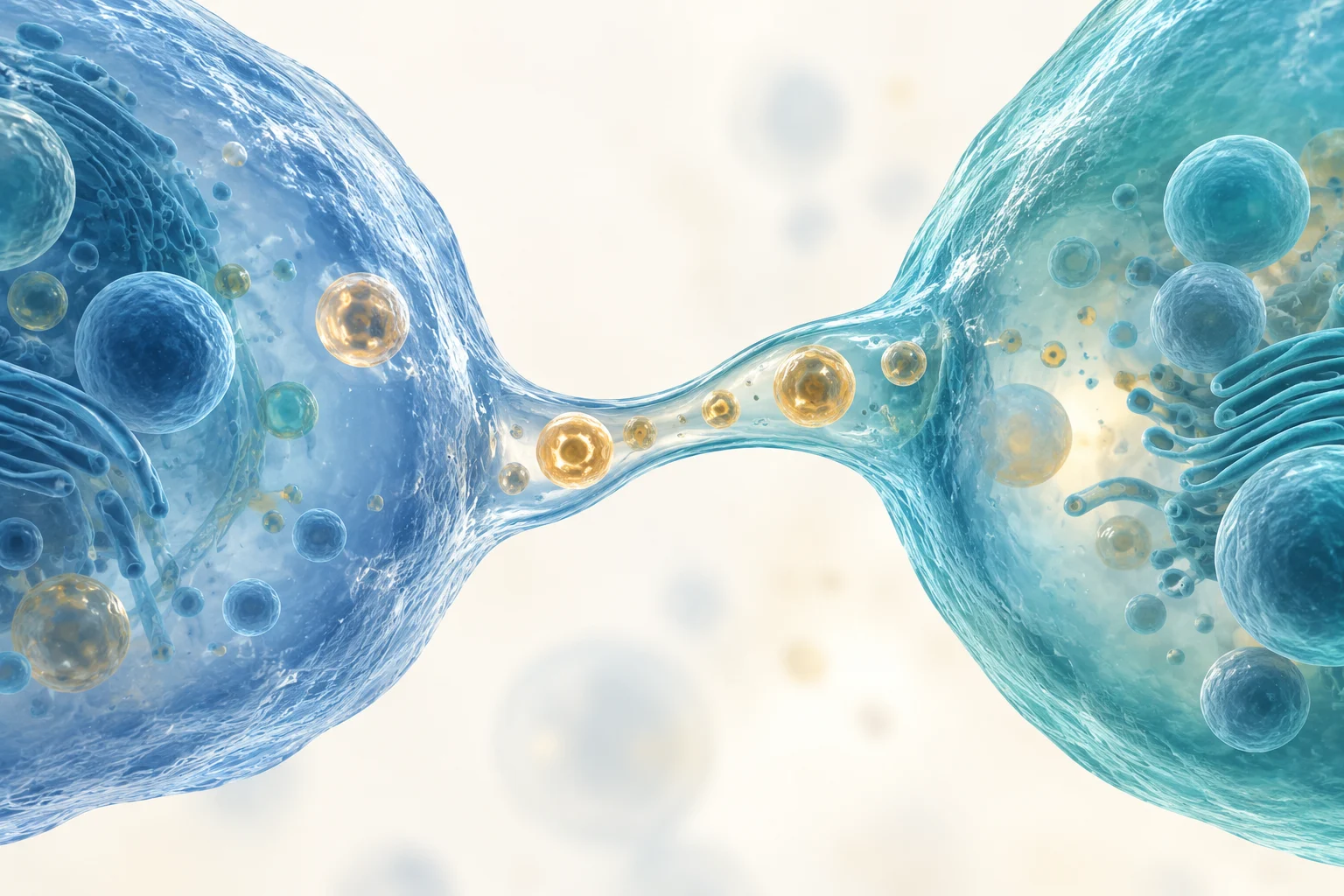
The image introduces cellular exchange and material recycling. It is not microscopy, a TM184C structure, or a claim about a particular transfer mechanism.
Read the source · Abstract and experiments · intercellular exchange and autophagy ↗- Source kind
- Structure-guided experimental biology
- Evidence reported
- Peer-reviewed article; Cellular experiments; Biochemical comparisons
- AI role
- Mining AlphaFold2 predicted structures helped identify GPCR-like protein candidates.
- Human role
- Researchers tested localization, molecular interactions, intercellular exchange and autophagy in experimental systems.
- Source date
- ; added 2026-10-15
- What it claims
- Structure-guided searching nominated TM184C; the authors report cellular and biochemical evidence linking it to intercellular exchange and regulation of autophagy.
- Why this could matter
- AI points toward an overlooked way cells exchange cargo Predicted structures can nominate proteins for experiments that investigate what cells do. The study informs basic biology; it does not demonstrate a therapy or clinical benefit.
- If it holds up
- Researchers gain a functional lead for studying cellular exchange and autophagy, and another route into poorly annotated proteins.
- If it does not
- Independent experiments would clarify which functions depend on the tested systems or experimental assumptions.
- Impact horizon
- Foundational · Cell biology · Protein function
- Version
- Nature version of record
- Why we tracked it
- A September experimental paper added as background for the cross-disciplinary collection; not newly published today.
- Highest-risk dependency
- Structure similarity nominates candidates; functional conclusions depend on experimental controls and model systems. Clinical benefit is untested.
- Available artifacts
- Journal manuscript, source data and supplementary material; no experiments reproduced by State of Proof.
- Current boundary
- Intake record only; examination not started. September peer-reviewed study added as historical context; independent examination and replication have not started. Predicted structure and experimental findings are distinct evidence types.