Warm rises, cold sinks—and the mathematics gets sharper
- What it is
- The paper claims a finite-time singularity in a simplified two-dimensional buoyancy-flow model with smooth forcing.
- Who did it
- Levent Alpöge and Tristan Buckmaster
- What it could mean
- No runaway heat required. Smooth forcing could drive temperature changes across tiny distances beyond any bound, while temperatures themselves stay finite—a striking breakdown in the mathematics of warm fluid rising through cooler fluid.
See the check plan
Evidence & validation
From announcement to evidence
Discovery recorded. State of Proof has not yet examined this claim.
Read the original work
Blowup for the Boussinesq Equations with Smooth Forcing ↗See the proposed checks
Do both forcing terms remain smooth through blowup, and do the formal hypotheses match the paper's localized solution class?
No proof docket yet
A docket is the public record of checks and open questions. This paper does not have one yet; the check plan above describes work still to do.
Explore existing proof dockets →
A sharper change without hotter extremes
Forced inviscid Boussinesq · two dimensions
∂ₜθ + u · ∇θ = fθ; ∂ₜu + (u · ∇)u + ∇p = θe₂ + fᵤ; ∇ · u = 0
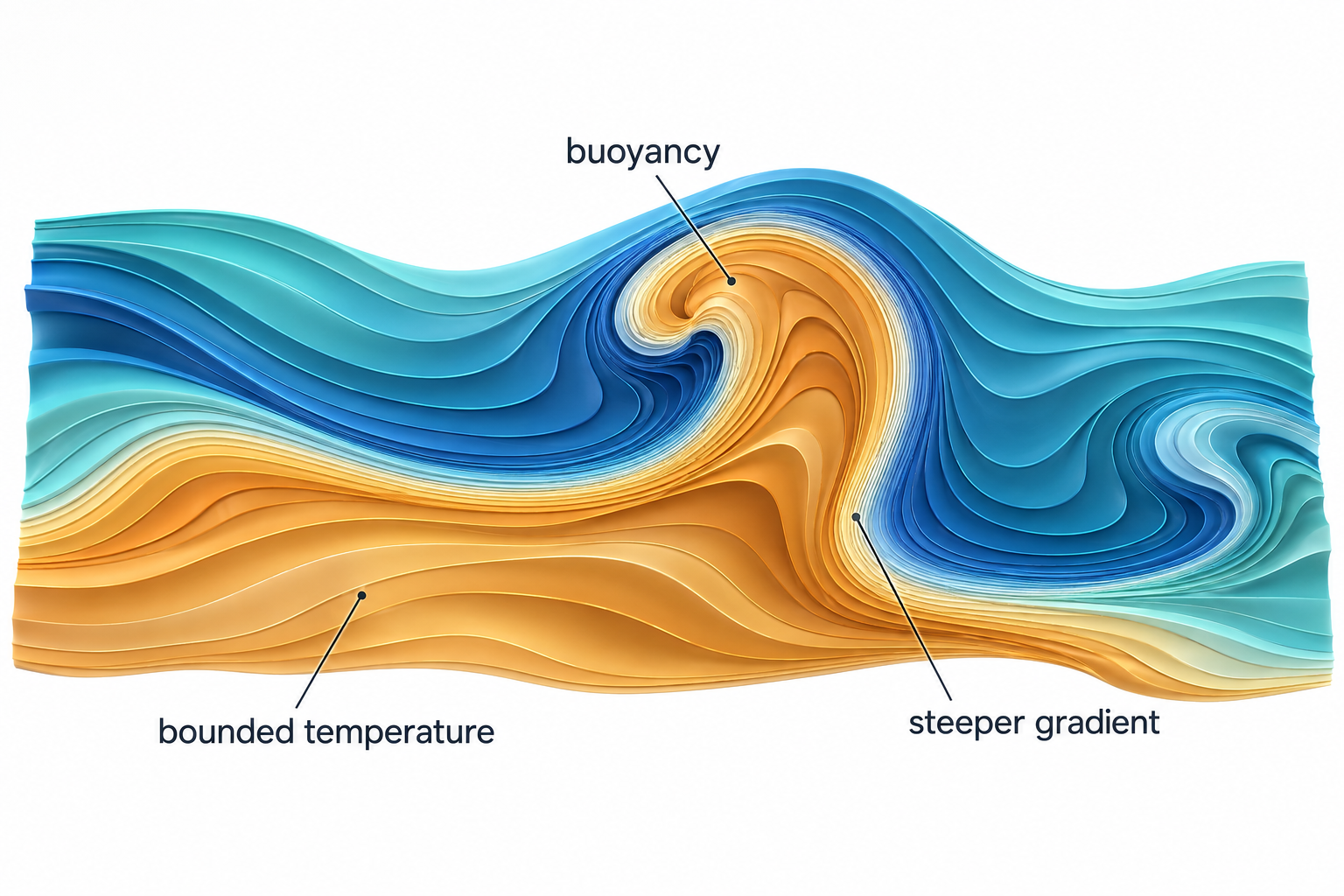
Warm and cool contours represent the temperature anomaly θ. Closer contours mean a sharper change across a smaller distance. The paper claims that temperature stays bounded while its gradient grows without bound, using a sequence of finer oscillatory layers and smooth forcing. This is a schematic of that distinction, not a computed temperature field.
Read the source · Equation (1.1), theorem 1.1 and section 1.2 ↗- What it claims
- The paper claims finite-time singularity formation in the two-dimensional inviscid Boussinesq system with smooth forcing, bounded temperature, and unbounded temperature gradient and vorticity.
- Why this could matter
- Warm rises, cold sinks—and the mathematics gets sharper Buoyancy helps warm fluid rise through cooler fluid. This simplified model asks whether smooth inputs can create arbitrarily fine structure while temperature remains bounded. The result could clarify the model's limits, not directly improve tomorrow's forecast.
- If it holds up
- It would establish a precise breakdown mechanism for a forced, two-dimensional buoyancy model and support further mathematical study.
- If it does not
- The claimed forcing or stability argument would need repair; it would not invalidate every buoyancy model.
- Impact horizon
- Foundational · Buoyancy · Fluid models · AI-assisted proof
- Version
- Public manuscript retrieved 2026-09-08; PDF SHA-256 895a628d1783bcb039374686f50b895b5f450f53b8ef8aa173523487a7a4a21b. Discovery date is not a claim of first publication.
- Why we tracked it
- The September 8 fluid-mathematics announcements warrant distinct intake records for each equation, forcing assumption and proof-completion state.
- Highest-risk dependency
- A forced, inviscid two-dimensional model. Not a result about all weather models. Formal and mathematical review by us remain pending.
- Available artifacts
- A public formal-source repository is linked: https://github.com/tristanbuckmaster/fluidlean. The shared authors' statement describes LLM-assisted work extending the Córdoba–Martínez-Zoroa program. No manuscript-linked code was executed; source availability is not proof verification.
- Current boundary
- Intake record only; examination not started.