Fluid through a sponge hides a difficult mathematical limit
- What it is
- The paper claims a smooth-forcing breakdown result for an idealized porous-flow model.
- Who did it
- Levent Alpöge, Tristan Buckmaster, and Matei P. Coiculescu
- What it could mean
- Water through rock seems gentle. Its mathematics may not be. This result would show smooth forcing creating infinitely sharp changes in an idealized porous-flow model—revealing a hidden limit of that description.
See the check plan
Evidence & validation
From announcement to evidence
Discovery recorded. State of Proof has not yet examined this claim.
Read the original work
Extending the Córdoba-Martínez-Zoroa IPM Blow-up to Uniformly Space-Time Smooth Forcing ↗See the proposed checks
Does the upgrade from spatial smoothness to joint space-time smoothness hold uniformly, and where does the new argument depend on prior work?
No proof docket yet
A docket is the public record of checks and open questions. This paper does not have one yet; the check plan above describes work still to do.
Explore existing proof dockets →
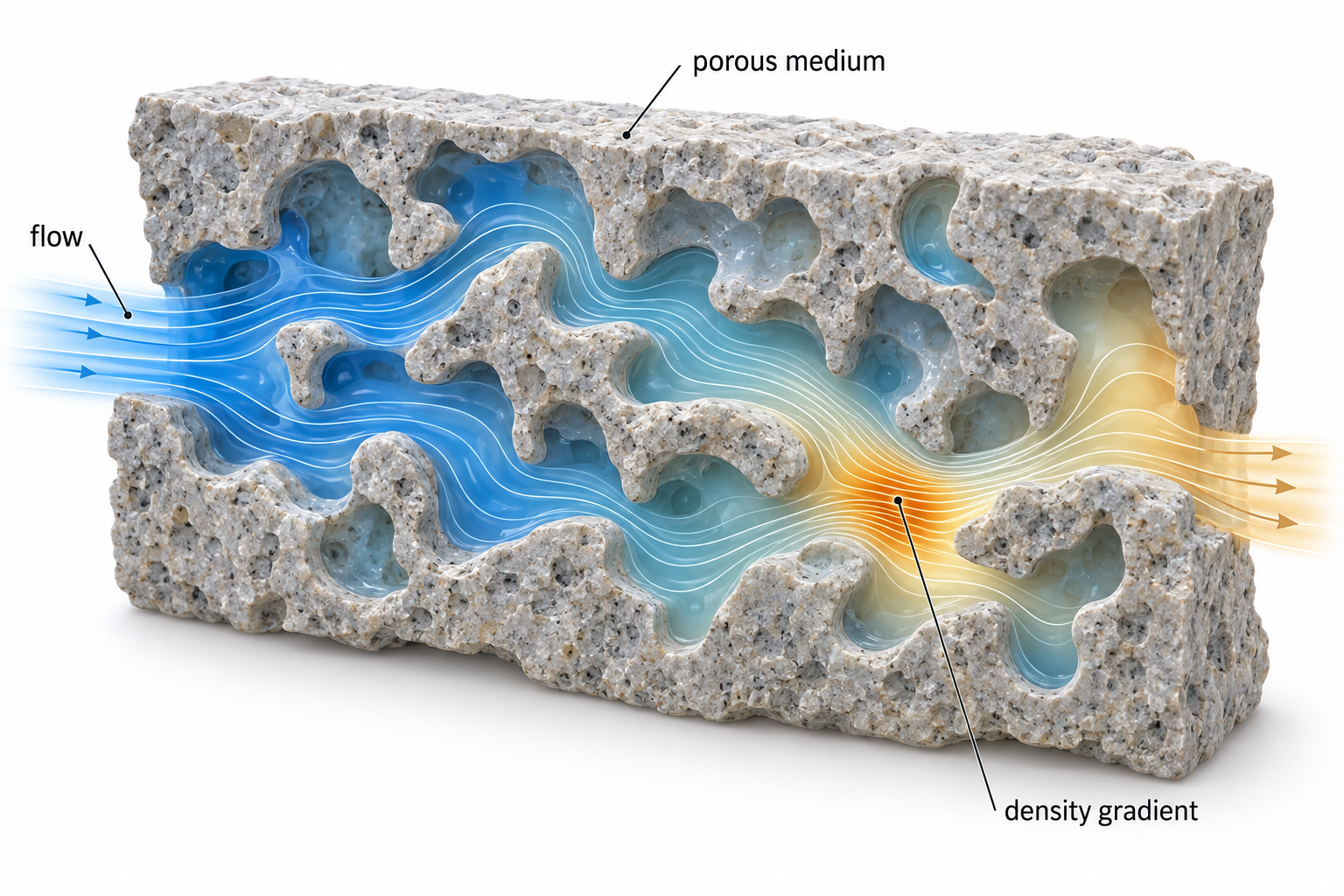
The physical idea behind porous flow
Periodic incompressible porous media · two dimensions
∂ₜρ + u(ρ) · ∇ρ = F; ∇ · u(ρ) = 0
The arrows and lines suggest flow through pores; the color change suggests variation in density. In the equation, ρ is density and u(ρ) is its Darcy velocity. The porous material illustrates the physical idea; the paper studies a continuum model with periodic boundaries, not this pore geometry. The picture is not simulation data.
Read the source · Introduction · periodic IPM transport equation ↗- What it claims
- The paper claims finite-time density- and velocity-gradient blowup for a periodic incompressible porous-media model with smooth initial density and a force smooth in space and time.
- Why this could matter
- Fluid through a sponge hides a difficult mathematical limit Think of water seeping through a sponge. This idealized porous-flow model asks how sharply density and velocity can vary under smooth inputs. Its value is understanding mathematical limits, not a demonstrated improvement to groundwater prediction.
- If it holds up
- It would extend a known singularity construction to forcing smooth in both space and time within the stated periodic model.
- If it does not
- It would expose the step that fails to preserve time smoothness or the claimed gradient growth.
- Impact horizon
- Foundational · Porous flow · Mathematical physics · AI-assisted proof
- Version
- Public manuscript retrieved 2026-09-08; PDF SHA-256 b3ebdbb8d9a93dcca5f3b3f8796e63f7f28b48e0b0e258b909110a4b69c72a12. Discovery date is not a claim of first publication.
- Why we tracked it
- The September 8 fluid-mathematics announcements warrant distinct intake records for each equation, forcing assumption and proof-completion state.
- Highest-risk dependency
- A periodic idealized model, not a physical reservoir experiment. We have not assessed the proof or established a paper-to-formal correspondence.
- Available artifacts
- A public formal-source repository is linked: https://github.com/tristanbuckmaster/fluidlean. The paper says Claude helped recover elements of prior work and Claude/Codex assisted writing and bookkeeping under the authors' direction. No manuscript-linked code was executed; source availability is not proof verification.
- Current boundary
- Intake record only; examination not started.