Navier–Stokes: can fluid equations hit a breaking point?
- What it is
- The paper reports a proof that smooth, forced three-dimensional Navier–Stokes flow can break down in finite time.
- Who did it
- OpenAI
- What it could mean
- Weather forecasts. Aircraft wings. Blood flow. Fluid equations underpin all three. This claim could expose a breaking point in forced, three-dimensional Navier–Stokes—even when the fluid starts perfectly still.
See the check plan
Evidence & validation
From announcement to evidence
Discovery recorded. State of Proof has not yet examined this claim.
Read the original work
Finite Time Blowup for Navier–Stokes ↗See the proposed checks
Map the exact paper and Lean endpoints to Clay alternatives C and D, including force regularity, initial data, energy and periodic pressure; then perform an isolated formal replay with pinned external checker tools.
No proof docket yet
A docket is the public record of checks and open questions. This paper does not have one yet; the check plan above describes work still to do.
Explore existing proof dockets →
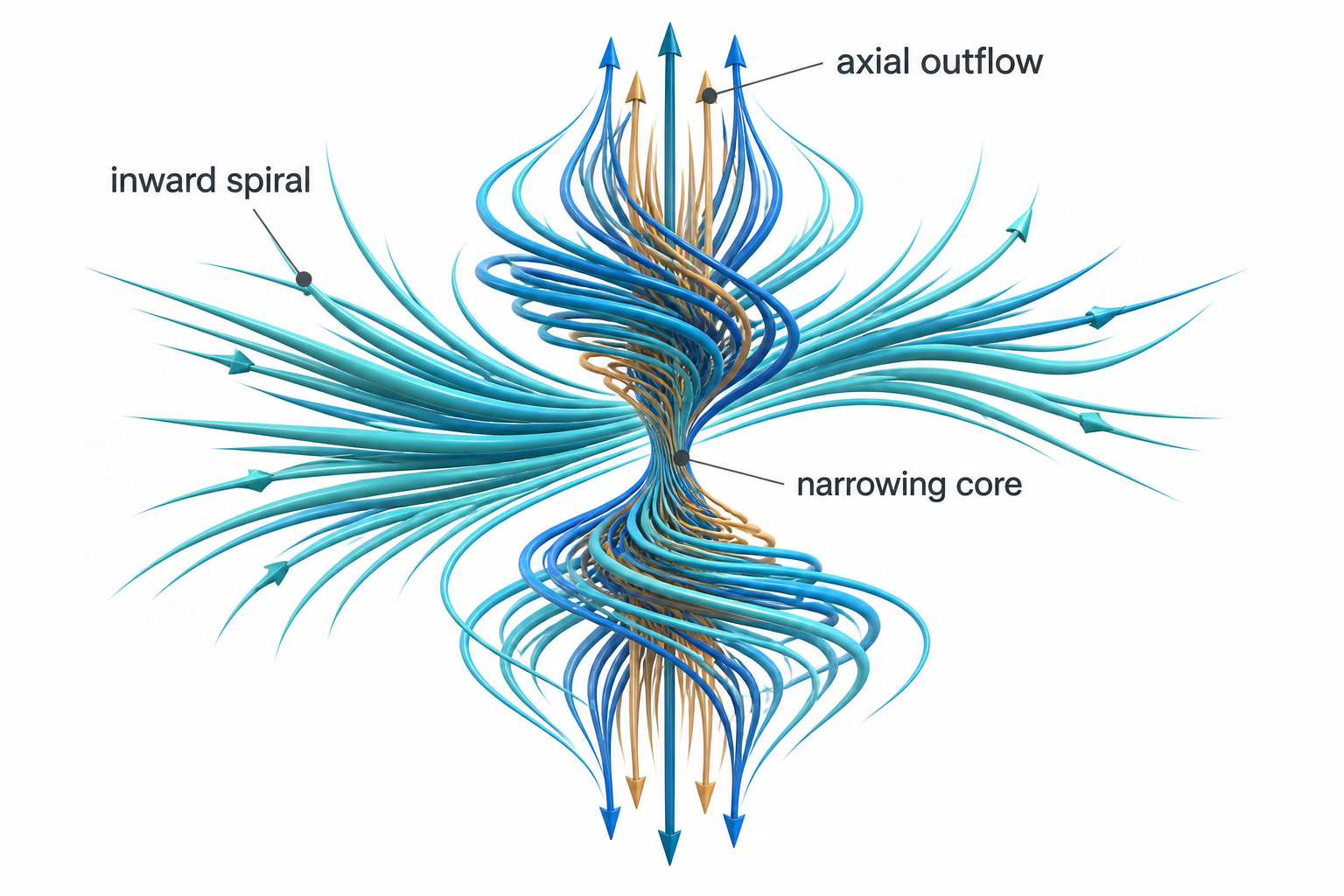
Inside the proposed vortex
Forced Navier–Stokes · three dimensions
∂ₜu + (u · ∇)u − νΔu + ∇p = f; ∇ · u = 0
Fluid moves inward around the axis and escapes along it. In the paper’s proposed construction, the active core becomes narrower as its speed grows. The drawing illustrates that mechanism; it is not a computed solution.
Read the source · Equation (1.1), section 2.1 and figure 1 ↗- What it claims
- OpenAI claims a finite-time breakdown of smooth, forced, three-dimensional incompressible Navier–Stokes flow from rest with bounded energy, asserting alternatives C and D of the Clay problem. This is the publisher's claim, not a State of Proof validation.
- Why this could matter
- Navier–Stokes: can fluid equations hit a breaking point? Wings, weather and blood flow all involve fluid equations. OpenAI claims that even smooth inputs can drive one idealized model beyond smooth behavior. This concerns the model's limits—not instantly better aircraft or forecasts.
- If it holds up
- It would resolve the forced breakdown alternatives of the Clay problem and sharpen research into when smooth fluid models stop applying.
- If it does not
- A gap would identify which assumption or proof step needs repair; ordinary engineering uses would not automatically become invalid.
- Impact horizon
- Foundational · Fluid models · Mathematical physics · AI-assisted proof
- Version
- Public manuscript retrieved 2026-09-08; PDF SHA-256 0e779481c4da40bd28d1e642e1d8ca57447d129610df28dfa5a11e9af8ae228f. Discovery date is not a claim of first publication.
- Why we tracked it
- The September 8 fluid-mathematics announcements warrant distinct intake records for each equation, forcing assumption and proof-completion state.
- Highest-risk dependency
- Whether the formal statement matches the complete manuscript and official Clay assumptions remains unassessed. Formal replay and expert review have not been performed by State of Proof.
- Available artifacts
- A public formal-source repository is linked: https://github.com/openai/NavierStokesAndEuler/tree/8937a8f4cbc7abaab5e9e97d1cc7f5d2319d9538. OpenAI attributes the work to an internal AI-agent system. No manuscript-linked code was executed; source availability is not proof verification.
- Current boundary
- Intake record only; examination not started.