Can an ideal fluid break down without an outside push?
- What it is
- The paper claims that smooth, unforced three-dimensional ideal-fluid flow can develop a finite-time breakdown.
- Who did it
- OpenAI
- What it could mean
- Even a frictionless, unforced fluid model could tie its own mathematics in knots. A verified result would show smooth motion breaking down without an outside shove.
See the check plan
Evidence & validation
From announcement to evidence
Discovery recorded. State of Proof has not yet examined this claim.
Read the original work
Finite Time Blowup for the Euler Equation ↗See the proposed checks
Does the formal endpoint establish the same smooth-data, whole-space, unforced theorem as the paper?
No proof docket yet
A docket is the public record of checks and open questions. This paper does not have one yet; the check plan above describes work still to do.
Explore existing proof dockets →
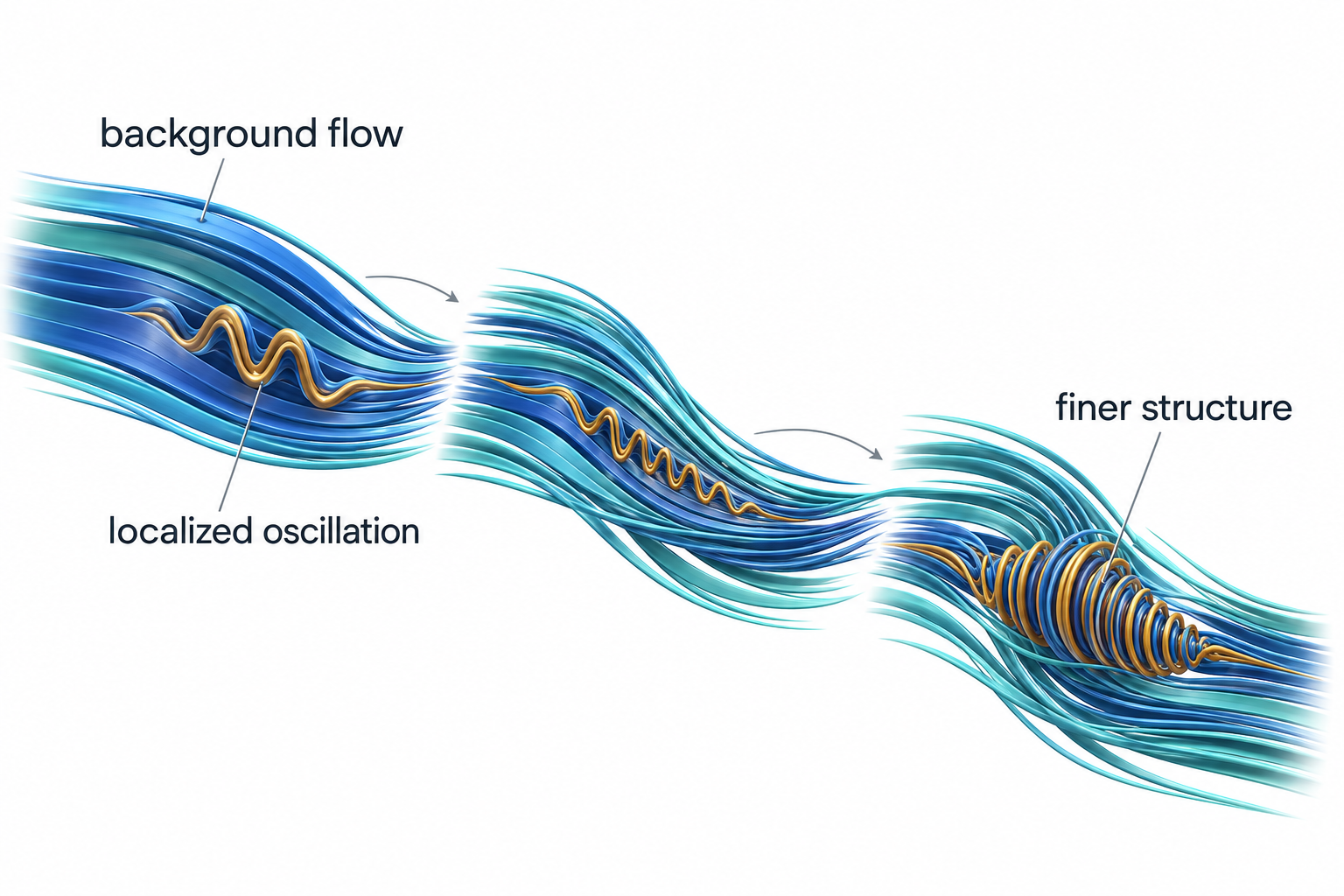
How finer structure is amplified
Unforced Euler · three dimensions
∂ₜu + (u · ∇)u + ∇p = 0; ∇ · u = 0
Each stage adds a localized oscillation to a background flow. In the paper’s construction, one stage helps amplify the next, producing increasingly large gradients. The panels illustrate the idea; they are not computed snapshots.
Read the source · Equation (1.1) and section 2 ↗- What it claims
- The paper claims finite-time breakdown for smooth, compactly supported initial flow in the three-dimensional unforced incompressible Euler equations.
- Why this could matter
- Can an ideal fluid break down without an outside push? Take friction and external pushing out of the picture. Can a smooth ideal flow still develop unbounded gradients? This paper claims it can, probing a fundamental limit of the equations used to understand fluid motion.
- If it holds up
- It would establish a smooth-data, whole-space breakdown example for unforced Euler, changing the mathematical picture of ideal-fluid regularity.
- If it does not
- The proposed construction would need repair; the general smooth-data question would not be settled by this argument.
- Impact horizon
- Foundational · Fluid models · Mathematical physics · AI-assisted proof
- Version
- Public manuscript retrieved 2026-09-08; PDF SHA-256 a0c234518e6c489e16996805023eb2e75c00b7c03455f7a3a5be2c124954bfdd. Discovery date is not a claim of first publication.
- Why we tracked it
- The September 8 fluid-mathematics announcements warrant distinct intake records for each equation, forcing assumption and proof-completion state.
- Highest-risk dependency
- A separate unforced Euler claim, not the forced Navier–Stokes claim. No proof execution or semantic correspondence review by us.
- Available artifacts
- A public formal-source repository is linked: https://github.com/openai/NavierStokesAndEuler. OpenAI attributes the result to a coordinating AI-agent system and provides a Lean formalization. No manuscript-linked code was executed; source availability is not proof verification.
- Current boundary
- Intake record only; examination not started.